Ask where AI data center energy comes from and you'll hear about substations, interconnection queues, and power contracts. Fair enough. But one supply chain running today starts somewhere stranger: a covered manure lagoon on a dairy in California's Central Valley. We operate that chain every day, so here is the whole thing, end to end, in plain terms.
It starts with cows
A dairy produces manure around the clock, every day of the year. On most Central Valley dairies, that manure gets flushed out of the barns with water and settles in an open lagoon. Bacteria break it down without oxygen, and the byproduct is methane, which bubbles up and drifts into the air.
That's the part worth caring about. Methane traps roughly 28 times more heat than carbon dioxide over a 100-year window, and more than that over 20 years. California took it seriously enough to pass SB 1383, a law requiring the dairy and livestock sector to cut methane 40 percent below 2013 levels by 2030.
So the raw material for this energy chain is a gas the state has ordered out of the sky. That one fact shapes everything downstream, including the carbon accounting that makes this fuel interesting to a data center.
The cover and the capture
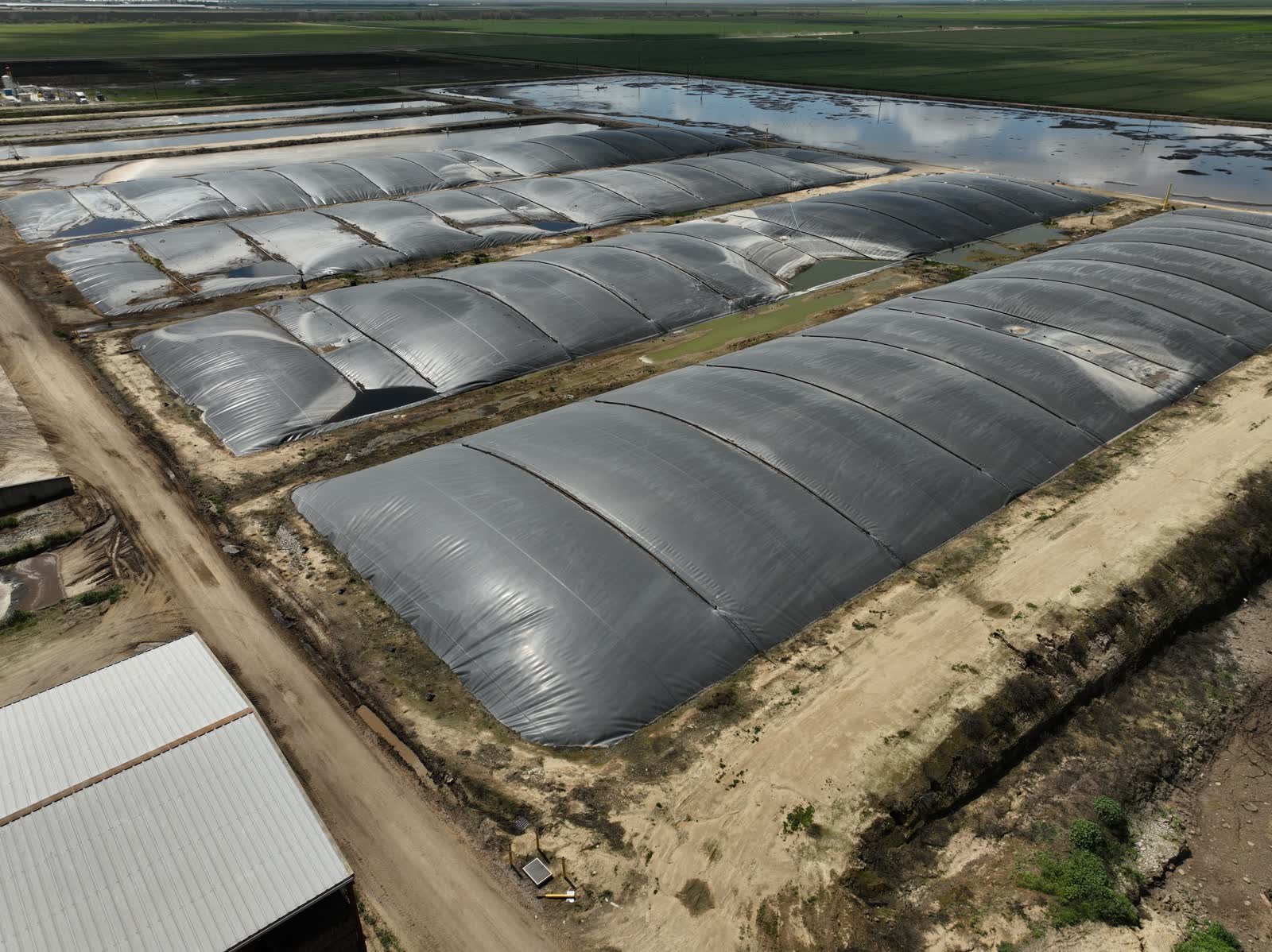
A covered lagoon digester is what it sounds like. You engineer the lagoon, line it, and seal it under a gas-tight membrane welded into one continuous cover. The manure keeps doing what it was already doing. The difference is that the methane has nowhere to go.
Gas collects under the cover, which swells like a slow lung. Piping pulls it off under light vacuum to a collection skid. An operator walks the cover, checks pressures, watches flows, and keeps the biology healthy, because a digester is a living system and it behaves like one. Feed it wrong and production drops. Tend it well and it makes gas around the clock, which is more than you can say for some generation assets.
Scale matters here. We built a 14-million-gallon covered lagoon digester, one of the largest in California. That is not a tank behind a barn. It's infrastructure, engineered and permitted like infrastructure.
The cleanup step
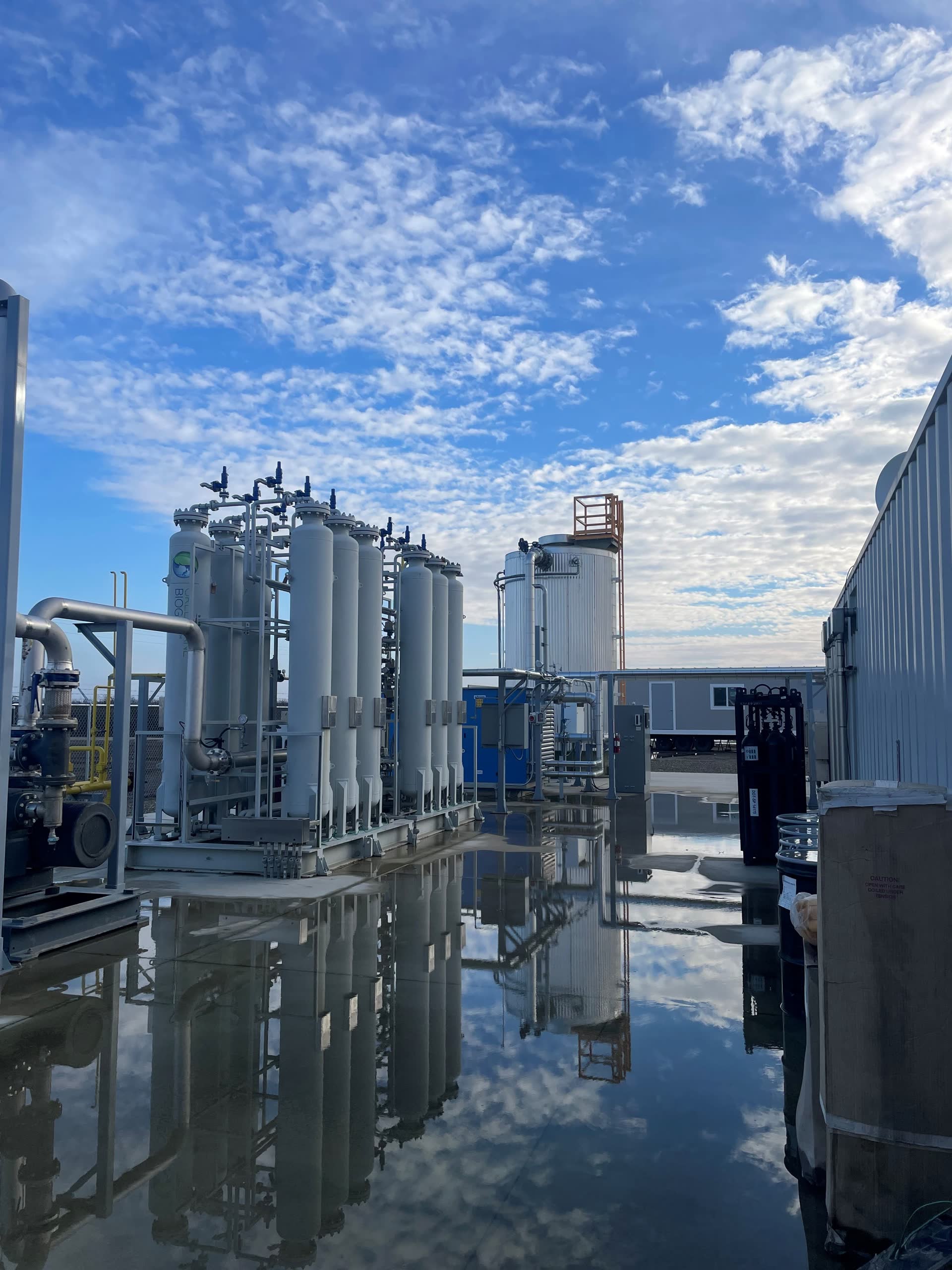
What comes off the cover is raw biogas: methane mixed with carbon dioxide, water vapor, hydrogen sulfide, and trace compounds. No pipeline will take that, and a generator won't run happily on it either.
So it gets upgraded. Moisture is knocked out. Hydrogen sulfide is scrubbed. Carbon dioxide is separated. What remains has to meet the same specifications as the fossil gas already in the pipe. At that point it has a name: renewable natural gas, or RNG.
The practical consequence is easy to miss. Because RNG meets pipeline spec, it runs in existing gas equipment. Pipelines, generators, gensets. No retrofits. A facility that already burns natural gas can burn this instead and nothing on the equipment side has to change.
Pipeline or wheels
Now the gas has to move. There are two ways.
If the dairy sits near an interconnect, the gas is injected into the common-carrier pipeline and flows with everything else. If it doesn't, the gas gets compressed and loaded into tanker trailers. The industry calls this a virtual pipeline. We call it Tuesday. Our own fleet hauls more than 12,000 loads a year between dairies and injection points.
The hauling detail matters more than it looks. Plenty of dairies with strong gas potential sit miles from any pipeline. Trucking closes that gap, which means the map of usable projects is much bigger than the map of pipeline interconnects. It also means somebody has to run a trucking operation with real discipline, in fog and heat, year round. We decided that somebody should be us.
What a data center does with any of this
Depending on geography and goals, dairy RNG reaches a compute buyer in one of three forms:
- As fuel for on-site generation. Natural-gas gensets running RNG give you dispatchable power and replace a diesel habit. Diesel backup carries both a carbon cost and a local-air cost. Gas gensets on RNG cut the lifecycle footprint.
- As pipeline gas, procured like any other gas supply, with the renewable attributes documented alongside it.
- As attributes alone, through book-and-claim. When the molecule can't physically reach your facility, you buy the verified environmental attributes instead. The gas is metered at the project, the attributes are tied to that specific project, and they're retired once so nobody claims them twice.
The accounting is where dairy RNG gets unusual. CARB's LCFS program scores fuels on lifecycle carbon intensity. Certified dairy RNG pathways score below zero, in the range of -400 gCO2e/MJ on public record, and Aligned-built projects are among them. The score is negative because the methane that would have vented from an open lagoon counts against the fuel's footprint. Capturing it does more good than burning it does harm, on a lifecycle basis.
On the federal side, Aligned-built digesters are listed in the EPA's national livestock digester database, and federal records credit our operating projects with over 125,000 metric tons of CO2e avoided per year.
One caution, offered plainly. LCFS credits reward low-CI fuel used in California transport, and voluntary buyers use verified attributes toward corporate targets, but the rules are specific and your situation is yours. Confirm the details with your own advisors. If you want the mechanics in more depth first, we keep a plain-English explainer at our learn page.
Who's doing this
Aligned Digesters is a family company in Madera, California. We were dairy people before we were gas people. We started building digesters in 2017 because the lagoons were already there and the methane was already leaving.
Today we design and build projects as a licensed California contractor (CSLB #1065612), operate them daily, and haul the gas with our own trucks. We own the whole chain because the people who built the thing also have to keep it running through a hot August and a wet January. If you're looking at the construction side itself, that part of the company lives at our EPC page.
That's the chain. Manure breaks down under a sealed cover, the gas gets cleaned up to pipeline spec, and a pipeline or a tanker carries it to a generator or to a ledger entry that a data center can actually verify.
If you're mapping energy or attribute purchases for AI compute and want to see how verified dairy RNG fits, start at See how to buy it. The people who answer are the same ones who walk the cover.