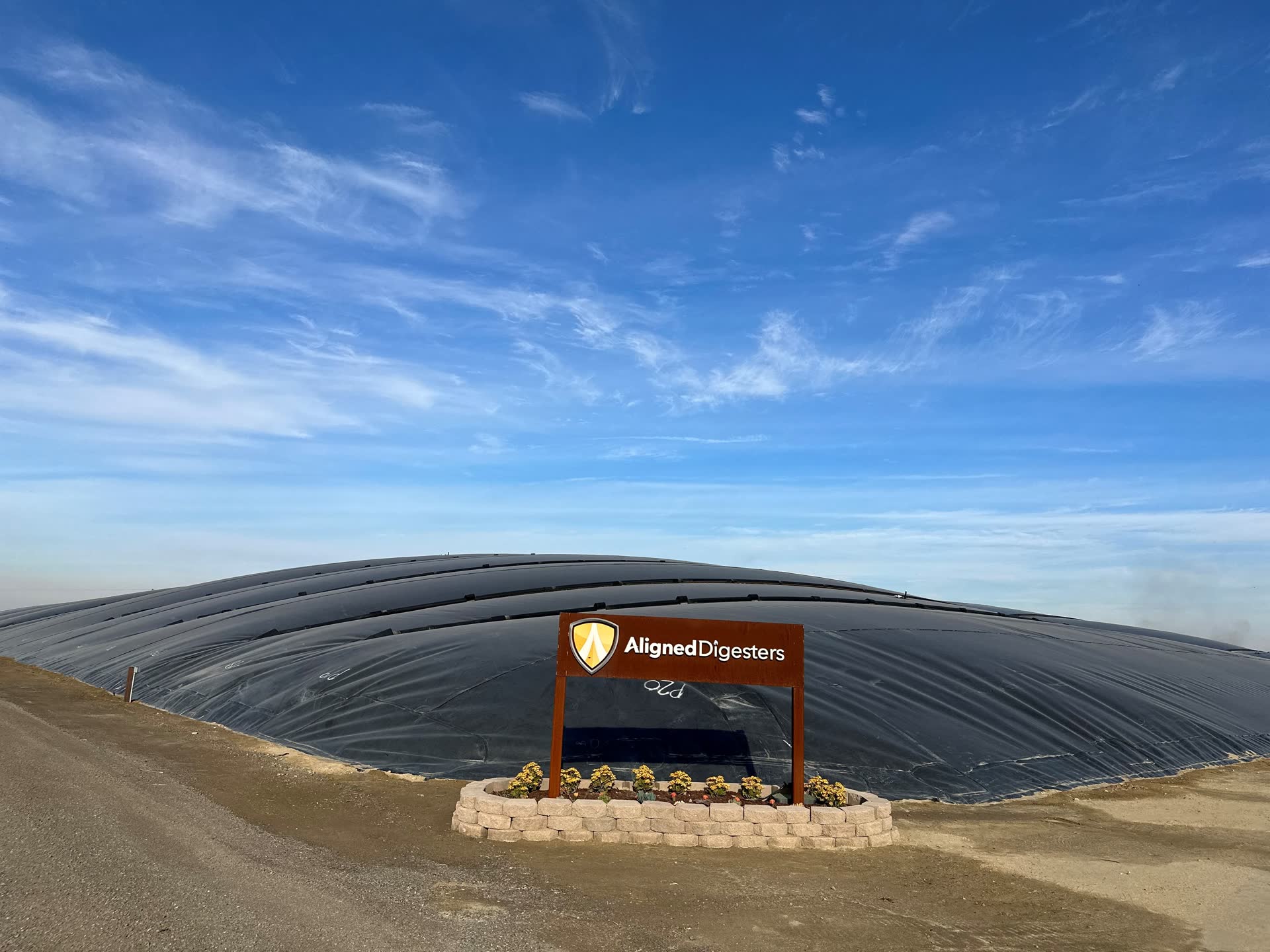
What is a dairy digester?
When manure sits in an open lagoon, it breaks down and releases methane straight into the air. A digester simply puts a heavy-duty cover over that lagoon, so instead of escaping, the gas gets captured.
Under the cover, the manure keeps breaking down naturally — no chemicals, no additives. That captured gas is called biogas.
We clean and upgrade that biogas until it's the same quality as the natural gas in a pipeline. At that point it's called renewable natural gas, or RNG — and it's worth real money.
Why now: the regulation is real
California passed a law called SB 1383. In plain terms, it requires the dairy and livestock sector to cut methane emissions 40% below 2013 levels by 2030.
Right now, participation in digester projects is voluntary. When you act early, you choose your partner, you negotiate your terms, and you have time to do it right.
A digester built today means you're ahead of the rule, earning revenue in the meantime, and free to focus on what you do best: milking cows.
What it costs you: nothing
Here's the model:
- We fund it. Aligned Digesters covers 100% of the cost. No capital from you, no loans in your name.
- We build it. We're a licensed contractor and we do the construction ourselves.
- We operate it. Our team runs and maintains the digester day in and day out.
- You share the revenue. Manure becomes a second income stream on top of milk.
- You make real progress on compliance. A digester is the most direct path toward the state's methane reduction target.
- You take on no added liability. The digester, its permits, and its operation are our responsibility, not yours.
What we handle with the government
Digester projects live and die on paperwork — permits, air district approvals, state programs, credit markets. That's our job, not yours.
We work directly with the agencies that matter: CARB (the California Air Resources Board, which runs the state's clean-fuel credit program known as LCFS), CDFA (the California Department of Food and Agriculture), and the local permitting authorities.
Our projects are listed in the EPA's national digester database, and we sell our gas under long-term contracts with major energy buyers.
The process, step by step
- 1. First conversation. We walk the site, look at your herd and your lagoon, and answer every question straight. No obligation.
- 2. Feasibility and terms. We evaluate whether a digester makes sense on your operation and put a clear agreement in front of you.
- 3. Permits and funding. We handle the engineering, the permits, the agency filings, and the financing.
- 4. Construction. Our crews build the digester. We schedule the work around your operation, not the other way around.
- 5. Gas flows, checks follow. The digester comes online, we operate and maintain it, and your dairy starts receiving its share of the revenue.
Questions dairymen ask us
Does it smell? Less than what you have now. Covering the lagoon traps the gas that causes the odor.
What happens to my lagoon? It stays your lagoon — it just gets a cover and does double duty.
Do I lose land? Very little. The digester uses your existing lagoon, and the gas equipment takes up a modest footprint nearby.
What if I sell the dairy? The agreement addresses that up front, in writing, before you sign anything.
How long is the agreement? These are long-term agreements — that's what makes zero-cost construction and steady revenue possible.
Does it disrupt milking operations? No. Your milking routine, your feed program, and your crew's day don't change.